



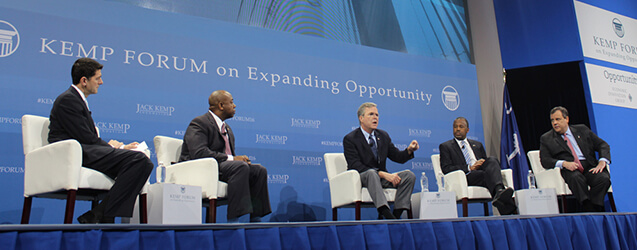
 COLUMBIA, SC — At a time and day – 8:30 am on a Saturday – when most Americans are sleeping in, the Kemp Forum on Expanding Opportunity convened in the capacious Columbia, SC convention center. Even at 8:15, it was tough to find a seat.
South Carolina’s important primary is Feb. 20, and doubtless some of the more than 1,500 attendees were attracted by the opportunity to hear from six of the Republican candidates for President. (It would have been seven, but Carly Fiorina missed her flight.) Jeb Bush, Ben Carson, Chris Christie, John Kasich, Marco Rubio and Mike Huckabee offered their views on how to fight poverty and expand opportunity. Ted Cruz and Donald Trump declined to attend.
The absence of Cruz and Trump was significant, underlining as it does one of the two competing ideas about what the Republican Party is and should be. Senator Cruz and, to a lesser degree, Mr. Trump seem to endorse the notion that Republicans can win national elections by motivating the “missing conservatives” who stayed home in past presidential election years because the party’s nominees were moderates. This is the line doggedly pushed by talk radio, but has been pretty well debunked.
There’s another interpretation of where the Republican Party needs to be — not just to win elections, but to reform the nation. It’s the reform conservatism approach embraced by Speaker of House Paul Ryan, who was one of the hosts of the Kemp Forum (the late Jack Kemp was Ryan’s political mentor). Ryan was joined by South Carolina Senator Tim Scott. Just by themselves, Ryan and Scott confound the image of Republicans as unlikeable or aloof or, in the oft-repeated poll result from 2012 that determined Mitt Romney’s fate, someone who doesn’t “care about the problems of people like me.”
“I hated being poor,” Ben Carson recounted. ”For years I thought I had been born into the wrong family.” Governors Bush, Kasich, and Christie spoke of their efforts to fight poverty through education reform, crime control, expanding the Earned Income Tax Credit, and block granting welfare programs. As Paul Ryan put it, “We’ve been fighting a war on poverty for over 50 years and I don’t think we can conclude anything other than that his war has been a stalemate. Fifty years, trillions of dollars, yet today if you are born poor, you are just as likely to wind up in poverty as you were 50 years ago.”
The discussion was wonky and sincere and mutually respectful. There were three panels featuring presidential candidates and interludes with South Carolina politicians Gov. Nikki Haley and Sen. Lindsay Graham. Not an insult was hurled. There was no chest thrusting, alpha male posturing. You could fantasize that this is what campaigns for President should always be. Poverty, Ryan argued, is not just a matter of “deprivation” but of “isolation.” There was much talk of drug abuse, poor schools, and the problem of incarceration. Kasich endorsed racial set asides, which may not win many plaudits from conservatives, and he, Chris Christie, and Mike Huckabee endorsed more drug treatment as an alternative to prison. The idea that we are incarcerating large numbers of people for simple possession of drugs appears to have become conventional wisdom, though it’s wrong.
Where conservatives shine is in their emphasis on the importance of mediating structures in the lives of the poor (and everyone else for that matter). The family, the church, and private charities can give people more than a check – they can provide the guidance, the supervision, the understanding, and even sometimes, the kick in the pants to get and keep people on the right track. To the degree that government elbows those mediating institutions aside, it creates the “poverty trap” – offering just enough support to keep people from destitution but then penalizing them for working to better themselves.
Will large numbers of poor people abandon the Democrats and vote Republican? Hardly. But when Republicans address the problems of poverty, they demonstrate their connection to ordinary people. Rubio noted that “If you are a child born into a broken family, in an unstable home, in a dangerous neighborhood, in substandard housing, in a school that’s failing in your community, where the people on the street corners are drug dealers or not good role models, you’ve got six strikes against you.”
One of the biggest strikes against Republicans is the perception that they are indifferent to the problems of everyone except bankers and entrepreneurs. The Kemp Forum was a well-placed blow to that image.
Published in Economy
PowerLine’s Paul Mirengoff has a different take on the forum:
In an article written by Karl Rove. Ironically it’s behind the WSJ paywall, so I couldn’t read it. I’m not poor, but I’m definitely not going to pay for Wall Street propaganda.
All this concern about poverty, proving we Republicans are compassionate and concerned as so much of the post emphasizes, doesn’t translate into votes. And even though I could become poor myself fairly quickly, is not even close to my first concern for America, especially not with poor foreigners pouring in non-stop.
I believe that private charities do much better than the government in helping with these problems, too. But I think Trump and Cruz were right to avoid this condescending virtuefest as a complete waste of time.
I can’t help but think if the people showing up to the forum were doing better in the polls they’d be out shilling in Iowa, New Hampshire and South Carolina. We are only a few weeks from the start of the primaries.
I’m actually surprised Marco Rubio wasn’t trying to displace Kasich in New Hampshire. If he comes in fourth he’s got a very rocky road.
This should have a “theology” Tag so folks could weigh in on what happens to ‘the soul’ when it dies? Or perhaps, the real issue: is there any merit to fighting for a figment?
An excellent example of how the GOP will destroy itself from within if it only follows the path promoted by Paul Mirengoff (which is not the view of most of his fellow Powerline writers, BTW). You do not persuade people to abandon the gravy train by promising that your only concern is cutting spending.
As Arthur Brooks explains in his latest book, the key to the culture is not the green eyeshade accounting posture, always about money and spending, but getting the structures right to allow the underclass to achieve “earned success”.
This forum is an example of what Dr. Bennett posits regarding winning the culture as more important than winning particular political battles.