



 After Citizens United, leftist jeremiads foretold the death of democracy as Big Dollars™ took over our politics, ushering in an age of plutocracy, avarice, darkness, greed, and doom (for starters). So, how’s that going? Very badly, it seems.
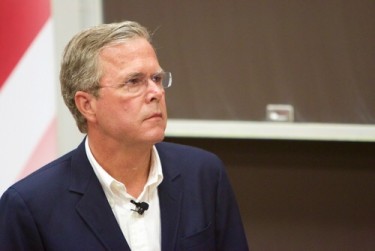
According to the NYT, the Republican candidates have raised about $242 million in direct donations to their campaigns, and their PACs and Super PACs have brought in an additional $312 million. Jeb Bush — Jeb! to his closest friends — raised very nearly 40 percent of that latter figure ($123.7 million), which has, to date, earned him the support of a single delegate via 2.8 percent of caucusers in Iowa. It’s not shaping up much better for him in New Hampshire, where Real Clear Politics expects him to get about 10 percent of the vote. In terms of campaign donations, Bush has raised about $31 million, which puts him behind both Carson and Cruz and just a little ahead of Rubio.
Among the other Republican candidates, Cruz comes in second in both PAC and campaign donations — split fairly evenly — and has raised a total of about $90 million. Rubio has raised $77 million, also fairly evenly split between PACs and campaign donations. Ben Carson has raised an incredible $54 million in donations, but his PACs have relatively little. Donald Trump has raised $19.4 million in donations and has no associated PACs (Trump also has billions of dollars of money in his own right, in case you didn’t know). Christie has raised $26.7 million in total with, interestingly, very nearly the same lopsided PAC-to-campaign ratio as Bush (a little under 4:1)
Among the Democrats, the figures are simpler: Hillary Clinton has raised an enormous $115.6 million in campaign donations, with a further $48 million to her PACs (Citizens United be damned). In contrast, Sanders has raised $75 million in donations and has no associated PACs. The result: a dead heat in Iowa and a likely Sanders victory in New Hampshire next week.
To the extent there’s a pattern here … well, there really isn’t one. Rubio, Cruz, Carson, and Bush all seem to indicate that it helps to have a balance between your PAC and campaign donations, but Trump breaks that pattern. (Doesn’t he always?) Clinton’s numbers might indicate just how far money can get an unlikable candidate. (Or they might not.) But if money really were the factor they warned of — especially PAC donations — then Bush should have walked away with this, and Sanders’ campaign should be flailing around like his hair the morning after he ate something off.
Money can’t buy love, they say. Seems it can’t buy votes, either.
Published in Politics
But it keeps Mike Murphy employed.
On second thought, who said money in politics wasn’t a bad thing?
Oh, I don’t know. It bought plenty for Cruz and Rubio. While I’ve been hoping and praying this election puts the Mike Murphys out of business, let’s not forget that #1 and #3’s surge was greased with lots of wealthy donor cash, and lots of consultants and “messaging people” on the payrolls.
Real question is whether it takes the teeth out of Hillary’s promise to get rid of Citizens United (to the extent that she still mentions it). Problem is, leftists don’t respond to this sort of real-life contradiction of their theories.
Like all Clinton issues , Hillary wants to get rid of Citizens United to stop Republicans from raising money and running ads against her, but she has no intention whatsoever that any restrictions would apply to her.
Of all the many reasons to be against Democrats, their desire to repeal the First Amendment should be at the top of the list.
“Money in politics” is just advertising. Nothing more and nothing less. Leftists equate advertising with mind control. If people can’t figure out that they are allowed to disagree with what they see and hear on billboards, yard signs, TV commercials, radio ads, etc., then we have a problem with education, not too much “money in politics.”