



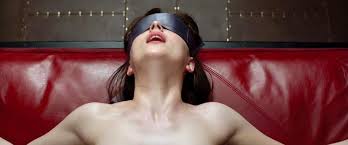
 Today is Valentine’s day and Hollywood has risen to the occasion by releasing the first of three movies that will be based on the Fifty Shades trilogy penned by Erika Leonard (better known by her pen name E. L. James). If you measure the significance of movies by the money they make, this one is a sure-fire winner. The books, which were issued in 2011 and 2012, have been translated into 52 languages and have sold 100 million copies worldwide. If you ponder the cultural significance of the trilogy’s success, it should give you pause.
The first volume, which forms the basis of the movie now in release, was entitled Fifty Shades of Grey. It had its origins in a series of episodes published on a Twilight fan fiction website. Leonard took as her first nom de plume Snowqueen Icedragon; she called her work Master of the Universe and conferred on its characters the names borne by Stephenie Meyer‘s characters in Twilight, Edward Cullen and Bella Swan. When readers objected to the sexually explicit character of what she wrote, Leonard left the site, rewrote the pieces, renamed the chief characters Christian Grey and Anastasia (Ana) Steele, gave the work the name it now bears, and began publishing it in dribs and drabs on her own website FiftyShades.com. In time, Leonard’s work was licensed by The Writer’s Coffee Shop, a virtual publisher in Australia; and, despite the fact that there was no marketing budget, the trilogy quickly took off. Eventually Vintage snapped it up.
No one with any taste or judgment describes Leonard’s work as well-written. As Tim Robey observed in The Daily Telegraph, its “prose style might charitably be described as unspeakable.” But despite the fact that the books are trite, treacly, and tedious, the trilogy nonetheless struck a nerve, and it clearly meets a felt need — which is puzzling. For the subject is bondage, domination, and sado-masochism (BDSM), and the audience is for the most part made up of married women over 30 years in age. In short, the Fifty Shades trilogy is porn — but not ordinary porn. This is Mommy Porn. Men, hitherto the usual purchasers of porn, have shown next to no interest.
I have not seen the film — though I have sampled the trailers and I have read reviews in a host of outlets including The Daily Telegraph, The Hollywood Reporter, The Baffler, Pravda-on-the-Hudson, Forbes, The Rolling Stone, Vanity Fair, and Newsday. By all accounts, it is a toned-down version of the novel — which makes sense. It is one thing to read about the infliction of pain. It is another thing to watch it. On the screen, at least, Mommy Porn has to be soft porn. The movie Fifty Shades of Grey differs from run-of-the-mill porn in only three particulars. The sex scenes are more frequent, the female lead is more often nude than is the norm, and one is repeatedly induced to anticipate her being lashed.
As Tim Robey puts it, the challenged posed to the screenwriter, Kelly Marcel, and to Sam Taylor-Johnson, the woman who directed the film, “was to please the books’ legion of (predominantly female) fans without allowing the film to become a soft-pornographic laughing stock.” She had this advantage, he tells us: she could dispense with Anastasia’s “bubblehead stream of consciousness,” by which he means “literary inner monologue such as this: ‘My heartbeat has picked up, and my medulla oblongata has neglected to fire any synapses to make me breathe,’ which Ana declares in one of the early chapters, as Christian announces he’s having a shower.” And she could have “the camera . . . occupy Ana’s point of view,” which was for the most part “a view of Jamie Dornan, the Northern Irish actor best-known for playing a hot serial killer in BBC Two’s The Fall.”
In Robey’s view, the enterprise has worked out “almost shocking well, considering.”
It proves that age-old saw that great books rarely make great films, whereas barely-literate junk can turn into something ripe and even electric on screen. The lead performances and sleek style choices sell it almost irresistibly to the target audience, but the film has the confidence to end bruisingly unresolved, with the structural equivalent of a slap in the face.
Meanwhile, for anyone who struggled to wade through the gruelling mire of James’s verbiage, it’s almost a form of revenge to watch the filmmaking slice through it, cleanly stripping off the fat. Great art it’s not – but it’s frisky, in charge of itself, and about as keenly felt a vision of this S&M power game as we could realistically have expected to see.
The film’s single biggest asset is [Dakota] Johnson [daughter of Melanie Griffith and Don Johnson], who has worked hard with [screenwriter Kelly] Marcel and Taylor-Johnson to perform a three-woman salvage job on the character of Anastasia. Gone is the book’s blithering simpleton, with her arsenal of “holy hell”s and “double crap”s and “oh my”s. Her inner goddess is, thank goodness, nowhere to be found or heard. She is at no point a quivering, moist mess, and doesn’t make the ruinous error of thinking the word “f___” is an epithet.
Instead, she projects an instantly compelling blend of vulnerability and spiky resistance – qualities that sometimes remind you of Griffith in her early roles. There’s more fight in this Ana than you’re ever expecting, and it raises the stakes during each stage of her seduction by Christian, from the moment she meets his eyes during an interview for her college paper.
Grey, for obvious reasons, is much more vividly described in the book than she is. Dornan, with his tousled hair and chunky build, is a precise physical match for this ludicrous fantasy-hottie-Bluebeard role, and somehow manages to render it only intermittently absurd. A good kind of absurd.
On purpose, he’s a little inexpressive at first: cold slate, with questioning eyes. The film doesn’t ever get totally under his skin and doesn’t want to – it needs to recoil, with a shiver of uncertainty, as we get to grips with his predilections.
The sex scenes clamber up the scale in intensity, without ever really threatening to get white-hot, and feature a lot more of Johnson than they do of Dornan. You could say she’s submissive to the point of baring all, from most angles, whereas he’s dominant enough to keep the camera from straying down where he doesn’t want it. Even when Grey, with his riding crops and cat-o’-nine-tails and Red Room of Pain, would claim otherwise, these sequences stay well within the bounds of vanilla mainstream taste.
And they offer an easy answer to the following question. Would you rather read an assortment of appallingly organised words describing two stick-thin characters yelping on the page, or watch two very attractive young stars going at it, in images filmed by Seamus McGarvey? This great cinematographer . . . is a ready-made cornerstone for the flatly indisputable argument that Fifty Shades is a far better film than it was a book.
Anastasia is no walkover here and sometimes gives as good as she gets, if not better. The funniest scene – debatably the sexiest, too – has the duo sitting at either end of a glass boardroom table, while Ana whips through the contract for their experimental relationship scratching out everything she won’t consent to. The script isn’t afraid to call a spade a spade here: “Find anal fisting. Strike it out.”
Johnson’s timing and verve are terrific, and manage to upend the more distasteful indignities of the book in gold-spun-from-straw ways. It’s her rebellion, not just her submission, that this version of Christian finds attractive, which gives Dornan something more interesting, human, and contradictory to play as well. If Taylor-Johnson and James bitterly tussled for control over this material, it’s a relief and even a bit of a thrill that the director came out on top.
Most of the other reviewers are less enthusiastic. Some think Jamie Dornan wooden. Some regret the absence of hardcore porn. More than one thought that the sex scenes should be a lot more steamy. Richard Lawson at Vanity Fair quite liked the movie but, with a hint of the regret that others voice with greater vehemence, he did acknowledge that
if the sex were more intense, Fifty Shades might actually become the transgressive sex fable it kind of wants to be, one that genuinely challenges our square notions of what is and isn’t deviant sex, that questions our perhaps rigid ideas of how power dynamics should function in a relationship. Free of full-frontal nudity and excessive thrusting and, well, orgasming as this movie is, it never gets to that envelope-pushing place.
By and large, however, even those who dislike the film confirm Robey’s depiction of Dakota Johnson’s portrayal of Anastasia Steele.
Next to no one, however, questions whether it is appropriate that Hollywood treat us on Valentine’s Day to a toned-down, soft-core version of bondage and submission on screen, and no one asks what Hollywood is up to, why Universal Pictures is seeking to mainstream sadomasochism. And no one at all ponders the larger significance of the fact that bored housewives fall for this stuff.
Sheri Linden at The Hollywood Reporter does remark:
Both on the page and in the glossy, compellingly acted screen adaptation, one of the more perverse aspects of their zeitgeist-harnessing story is the breathless way it melds the erotic kink known as BDSM with female wish-fulfillment fantasy of a decidedly retro slant. Hearts and flowers are barely concealed beneath the pornographic surface, and as with most mainstream love stories, an infatuated but commitment-averse male is in need of rehabilitation. . . .
The movie . . . wants to have it both ways: Informative and nonjudgmental about bondage and discipline, it distances itself from such pursuits with shard-sharp slivers of backstory, indicating that Christian’s desires are expressions of trauma-induced pathology. He’s supremely dreamy damaged goods, ripe for the saving. And so the moonlit postcoital sonatas he plays at his piano — interludes of self-conscious melancholy that are among the most laugh-out-loud schmaltzy in the book, transplanted whole to the screen.
But that is as far as it goes, and one is left with the impression that Linden is less bothered by the “erotic kink” than by the “female wish-fulfillment fantasy of a decidedly retro slant.” In her outlook, like virtually all of the other reviewers, she appears to be resolutely nonjudgmental — which is another way of saying amoral.
The only real question anyone poses is whether the movie is somehow sexist. Here is the answer that Scott Mendelson provides in Forbes:
Yes, the film concerns young, naive, and impossibly attractive Anastasia Steele (Dakota Johnson, who sells the hell out of this film) being seduced by the slightly older, insanely wealthy, and ridiculously good-looking Christian Grey (Jamie Dornan, stuck with the worst lines but doing everything he can to sell it too). And yes the relationship quickly becomes one that involves domination, control, and periodic bouts of soft-core BDSM. But through it all, Anastasia Steele (which is a really great name for a James Bond villain or an Ayn Rand character) not only is awakened sexually but also finds herself completely in control of this unorthodox relationship. The only “sexist” thing about the overwhelmingly sex-positive picture is that we see so much of Ms. Johnson’s naked body but so little of Mr. Dornan’s.
Because Mr. Grey insists on explicit consent and will not proceed until Ms. Steele provides it in writing, it is the virginal would-be flower who calls the shots for much of their relationship. The highlight of the film is a matter-of-fact and rather blunt contract negotiation as Ms. Steele details what she will and will not consent to should she agree to be Mr. Grey’s “subservient.” Not only is it deliciously entertaining and an “I’ve never seen that before” moment, it features Ms. Steele at her most confident and thus her most attractive. Considering how much ink has been spent discussing the notion that fans of the book got off on the notion of being dominated and/or being controlled, it is worth noting that the most potent fantasy to be found is one of a single, sexually liberated woman being in control of her body and her relationships without judgment or scorn from either herself or any outside forces.
It seems to me that, if one wants to get to the bottom of this phenomenon, one must go back to the most politically incorrect article ever published in The American Spectator. I have in mind the piece, entitled “In Defense of Rape” and available online, that appeared in the 1 June 1976 issue (Volume 9, Issue 9) of that puckish journal. The author — who was, if I remember correctly, the director of the library system at the University of Iowa — chose for herself the pseudonym Helen S. Clark.
The title and the first couple of paragraphs were intended for shock value. What came after was serious. Ms. Clark, as she called herself, was no friend to rape, but she was interested in rape fantasies, and she knew that she was not alone. “A glance,” as she put it,
at any paperback bookstand proves that the publishing industry relies heavily on novels of romance. But this, lust and mush, is the only genre which does not attract both sexes. As any librarian will attest, cowboy novels and tough-guy adventures are read by women as well as men. But only women read romances — an interesting observation since it hints that the rituals of love which are reaffirmed in both every romance and every reader’s heart are peculiar only to women, that the mystery of the female (which is really quite simple) is, all protestations aside, really not too fascinating to men.
But lest you misunderstand, let me tell you briefly about myself. I am a woman executive — I hire and fire. I handle grievance procedures. I go to business lunches, and even on occasion (now get this) pick up the tab. My salary hovers in the top five percent of female workers in the country. I still receive enough proposals of marriage not to worry about it, and I am very pretty. And I read these books. I positively cannot put them down, and I must even ration them out to my seething soul, lest my mind turn to gray slush, and my sensitivity to throbbing tastelessness.
Later, lest we misunderstand, she tells us a little more about herself:
I was raised by two homesteading parents in the Alaskan woods. We — my mother, sisters, father, and I — pulled stumps every year. We cut down trees and dragged them from the woods to our home. We shot moose and packed in the carcasses. We built cabins. My father called us “you guys.” My mother lamented when we discovered lipstick. So you must realize, all you skeptics with suspicions of social indoctrination, I was not conditioned to be a female — I was simply born one. And it would be as foolish for me to deny this as it would be for a man to deny that he would really rather be a cowboy.
Helen Clark did not pick up the bodice-rippers she reads at K-Mart. She learned about them from her colleagues and friends. “I know from first-hand experience,” she adds, “that scratch any female, and you will find flutter: we all wear French cambric and scalloped lace with much more grace than we wear sweatshirts and blue jeans, and we waltz ever so much better than we march in street demonstrations.” In the regency novels that she and her friends prefer,
there is a stock plot which no reader would ever want altered. The novels are usually written in the third person, since things have to happen to the heroine which she does not understand, and the restrictions of the first person strain the naivete. She is generally misunderstood, or at least underestimated, by her family and associates and is always a virgin. She can on occasion be a hellion, but if so, she has a basic sensitivity which pulls her through. She always has a mind of her own and is more intelligent than all men, save one. She does not have to be beautiful — a significant point, considering the vulnerabilities of the audience. She frequently has eyes too far apart and a mouth a bit too wide. One [Georgette] Heyer heroine was a real dowd and got away with it.
On the other hand, the hero is always handsome. He may have cruel eyes, but we will take care of that. The veteran reader knows instantly when the hero comes on the stage because he sneers a bit and has gray eyes. . . . The man is jaded from years of high living and too many women. He has met no one whom he has loved — ardent affairs may splotch his past but not real love. He is wealthy and titled, preferably a duke. He knows hunting, horses, and boxing. He gambles but not to abandon, and is not above a duel now and then.
As you can see, the Fifty Shades trilogy is treading familiar ground — albeit in a new fashion. Helen Clark’s favorite writers — Georgette Heyer and Barbara Caitland — are not coarse. The kissing is generally left to the end. The subject is “the excitement of seduction.” We hear a lot about “the smouldering eyes of the hero.” He may touch the heroine’s arm, and this has a powerful effect on her. That which is genuinely obscene is kept “off stage” in keeping with the etymology of the word.
Clark’s article is aimed at the feminist icon Germaine Greer — “a woman who ought to know better” but “isn’t smart enough to understand what’s going on here” — who devotes an entire chapter of The Female Eunuch to the phenomenon and who claims that, “if women’s liberation movements are to accomplish anything at all, they will have to cope with phenomena like the million-dollar Cartland industry.” Greer’s answer to the challenge posed by “romantic trash” is “hard-core pornography.”
The titillating mush of Cartland and her ilk is supplying an imaginative need but their hypocrisy limits the gratification to that which can be gained from innuendo: bypass the innuendo and you short-circuit the whole process.” I and my friends swapped True Confessions back and forth because we were randy and curious. If you leave The Housewives’ Handbook [on Selective Promiscuity] lying around your daughter may never read Cartland or Heyer with any credulity.
Clark thinks that this is utter nonsense: “There is no ‘short-circuiting’ at all. Prurient interest and romantic urges are as far apart as are, say, Increase Mather and Jacqueline Susann.” In her opinion, “Novels of romance are not a flirtation with pornography and in fact are just the opposite since the purpose of pornographic literature is to describe reality for those who aren’t fully enjoying it.”
Miss Greer should realize that one just cannot get around the truth that romance is more important to women than to men, and since women are so strikingly unique in maintaining this interest, she should begin to wonder why. With apologies for the obvious, I must say that it is the primary purpose of all animals to perpetuate themselves and that furthermore it is the responsibility of the female to see to it that the job gets done. It conveniently happens that every little cell in her body is attuned to this charge, and, as with all the really big things in life — God, growing up, death, etc. — intelligent beings have a tendency to ritualize the things their cells, nerve endings, and hormones so disturbingly tell them to do. The programming is there, nagging and insistent, and I wouldn’t dare, for the sake of my insanity, attempt to defy all my little cells when they tell me to cast a commensurate sidelong glance. The ritual merely lends grace to the task and disguises the enormity of its truth.
Helen Clark is aware that there are romance novels in which violence and even rape loom large. One such work — Lola Burford’s Vice Avenged — she discusses at length, noting that it is dedicated to Heyer and arguing that Burford “has merely translated the respectable flirtations” described by Georgette Heyer and the like “into rape and the final physical act into spiritual conquest.” She is “not necessarily more honest than Heyer. She is merely more direct.” In her opinion,
Rape as a ritual of love exists in the fantasy world of every woman. It is a man saying to a woman that she is so desirable that he will defy all rules of honor and decency in order to have her . . .
Male violence is outward-directed — posses go after bandits, people get shot, battles roar. Female violence is inward — torture, beatings, rape. Males do things to other bodies. Females have things done to their own. I cannot recall one female novelist who described a beating, for instance, that happened outside of her own character. . .
Women use violence in fiction for the same reasons men do. They are playing to a common human quirk that is a little more than the yen for excitement. It is the attempt to exploit emotion through physical action, and since the most physical thing that can happen to a body is, with the exception of lovemaking, pain, it is inevitable that violence finds its way into all sorts of fiction.
When I first read Helen Clark’s essay almost 40 years ago, I found it shocking. That was without a doubt the author’s intention. Even today, I find it disturbing. But about it I have always been inclined to say this: It is the only serious attempt I know of to make sense of an aspect of feminine conduct that I have always found puzzling. The other discussions of the phenomenon that I have encountered are, like that in Greer’s Female Eunuch, preachy and therapeutic. They all insist in the manner of Henry Higgins that a woman should be more like a man.
It is sometimes said that art imitates life, and sometimes it does. What can be asserted with greater confidence is that life frequently imitates art. Juliet accuses Romeo of kissing by the book, and many an American Romeo has learned to kiss from watching movies. The folks in Hollywood understand this — which is why it is worth asking what they are trying to do, apart from making money, with the movie Fifty Shades of Grey.
I suspect that, if the lady librarian who published a shocking essay nearly 40 years ago under the pseudonym Helen S. Clark were in a position to have her say today, she would tell us that Hollywood has appropriated the conventions of the Regency novel for the purpose of moving us ever so gently from romance to the hard-core pornography treasured by Germaine Greer and her twisted sisters. This year on Valentine’s Day we get Fifty Shades of Grey. Next year my bet is that we get Fifty Shades Darker, and I suspect that we will be treated to Fifty Shades Freed the year after that — and step by step the soft-core pornography of the first film will give way to the hard-core pornography so prominent in the later volumes. Stay tuned.
Published in General
Yesterday, — when I wrote, “And no one at all ponders the larger significance of the fact that bored housewives fall for this stuff” — Mollie Hemingway had not yet posted on that subject. Now she has, and what she has to say is worth reading.
I’m not at all sure you can blame “Hollywood” for a book publishing phenomenon or assign it a role in guiding the public towards the attitudes in the books. Hollywood didn’t make this weird trilogy successful; women did, the vast majority apparently middle class, white, and married.
The old oversimplification has some truth in it: “Men are stupid. Women are crazy”.
I read Mollie already, don’t need to read more nonsense. Look at all the space you took up with this garbage. Are you pushing the movie maybe? Or even the book. This is the 3 or 4th post on Ricochet of this non subject.
Hollywood is responsible for the movie, not the book. And the folks in Hollywood are masters of the art of manipulation. They often have a sociopolitical intention.
When a trilogy of books sells 100 million copies in three years and gets translated into 52 languages and when Hollywood produces a blockbuster, one ought to pause and ask what is going on. Neither the books nor the movie needs — or could get — any pushing from me. I am not urging you to see the latter or read the former. I am urging you to think a bit about the audience for both and about the ground moving beneath our feet.