















































ricochet.com
Open link
Ricochet will work fine in a browser on your mobile devices, but for the best experience please download our app.


Tired of the toxicity of social media? Why not join Ricochet for just $5/month? Think of it as an online bar. Come in, have a drink, hang out, say whatever you want. But don’t badger, bully, or berate the other drinkers. That's our only rule.
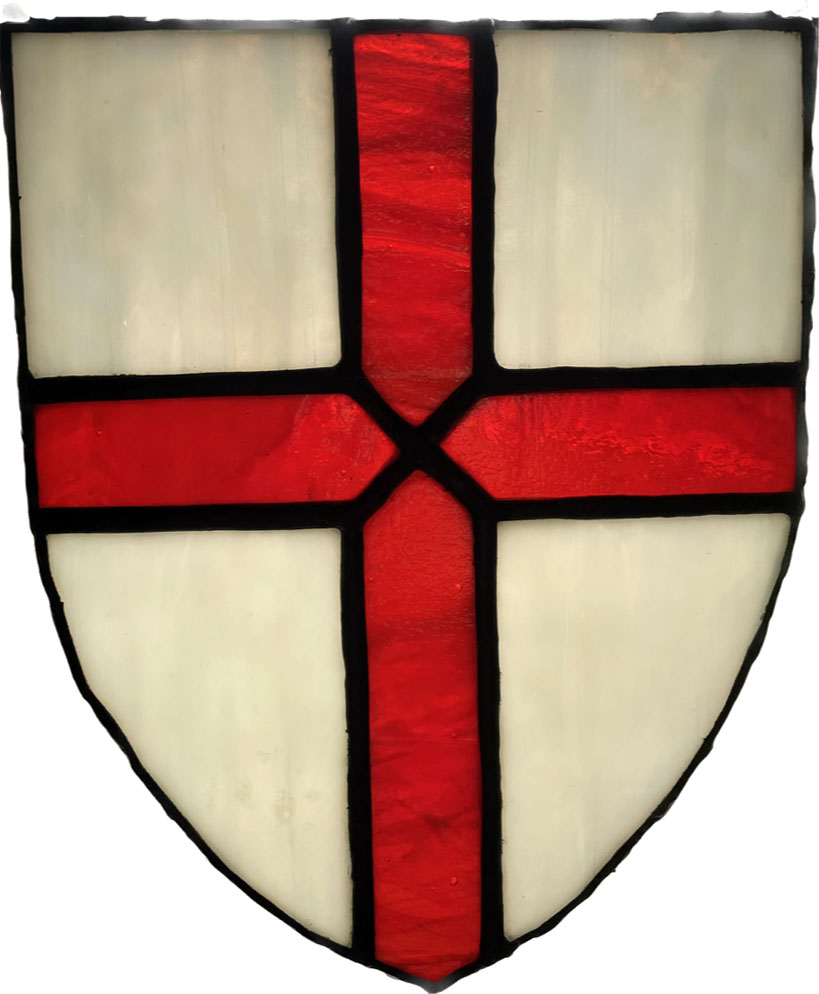
Nine years on, I'm indulging myself by reprising my original St. George's Day post. In the intervening years, the news from England has become more and more depressing, and we are now at a point where even displaying the "Bloody Cross" is deemed by many in the UK--seemingly uniquely, when it comes to both real and pretend flags of the world--as an offense and a demonstration of racial and religious aggression.
Still, there are those fighting back, such as Ryan Bridge, the founder of the "Raise the Colours" movement, which erects both Union Jacks and the flag of St. George on English lampposts. (Bridge was arrested on April 2, 2026, on "suspicion of causing religiously and racially aggravated harassment.") A little further on in the linked Guardian article, we have:
In recent days, the Raise the Colours group has posted several videos of its members erecting flags in Oxfordshire. On Monday, Oxfordshire county council issued a legal notice banning the group from putting up flags, arguing it was an “act of intimidation and division”.Apparently, according to the Liberal Democrat councillor Liz Leffman, Ryan Bridge and his band of merry flag-setters have caused local Oxfordshire residents to feel "distressed, unwelcome, and unsafe." Leffman is sure that those erecting Union and English flags in Oxfordshire are not demonstrating patriotism, but are only concerned with acts of "intimidation and division that [are] having a real and damaging impact on our communities."
Meanwhile (I can't help myself) I see that the Palestinian flag flew proudly over Oxford Town Hall on December 15, 2025, while the Mayor of Ramallah visited its Twin City in what Councillor Louise Upton called "an important opportunity to reaffirm our connection and explore new ways to work together at a challenging time in Palestine's history."
So, just to be clear: "Palestinian" flags to "reaffirm connection" with some sort of vague modern-day globalism to a country that doesn't actually exist, totally OK. English and UK flags to "reaffirm connection," in England, with the British, makes people feel "distressed, unwelcome, and unsafe." Got it.
About six months ago, I had occasion to drive to Butler, PA (yes, that Butler), where I'd found a lovely little book bindery that was restoring and re-covering my late Auntie Pat's 100-year-old Bible. I was so taken by my trip down Main Street, Butler, that--while paused at a stop light--I took a photo and sent it to my sister in the UK:
This went on, on both sides of the street, on virtually every building, for over a mile. God Bless America.
And now, "God for Harry [not that Harry], England, and Saint George!"
" data-post-author="She" data-post-title="A Bloody Cross<a class=""post-edit-link"" href="
">
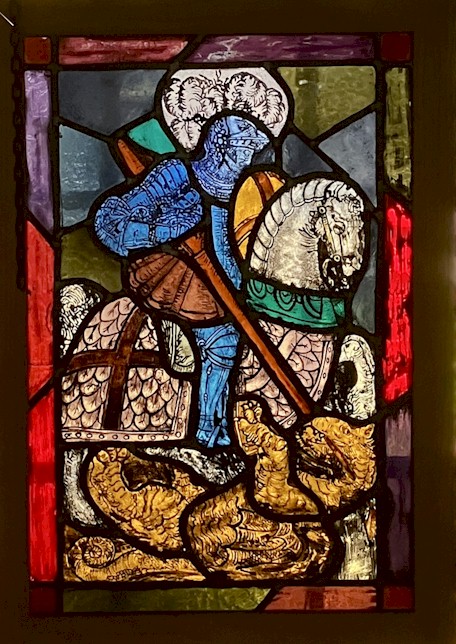
Tradition has it that, on April 23 in AD 303, a young and promising Roman soldier in the army of the Emperor Diocletian was beheaded after gruesome torture, and died professing his Christian faith to the end.
Very little is known of his life, but it’s believed he was born into a devout Christian family, perhaps in Cappadocia, an ancient district of Anatolia, somewhere between AD 270 and 280, and that he was raised at least partly in his mother’s home city of Lydda (Lod), in what is now central Israel.
After joining Diocletian’s army, he rose quickly, becoming a Tribune and then an Imperial Guard for the Emperor himself. When Diocletian announced in AD 303 that all Christians serving in the army must offer a sacrifice to the Roman gods, our hero refused.
Diocletian, uncharacteristically, stayed his hand for a bit, out of respect for his friendship with the young man’s father, but eventually had him cut to pieces on a wheel of swords, and then beheaded, on April 23, 303.
His body was buried in Lydda, and a shrine was erected to his memory in the church there. One hundred ninety-one years later, he was canonized as a saint by Pope Gelasius I, being among those “whose names are justly reverenced among men, but whose acts are known only to God.”
Over time, as is wont to happen with those who die so bravely and so publicly, a legend built up, and began to surround, our hero. By the 12th and 13th centuries, it was codified in several manuscripts, most famously in the Legenda Aurea of Jacobus de Voraigne, the Archbishop of Genoa.
In the best tradition of medieval storytelling, the Archbishop’s account involves a knight, a lady, and a dragon. It goes like this:
A town in what is now modern-day Libya once lived in thrall to a large dragon that inhabited the pond outside its walls. Only by sending one or two sheep each day to placate it could the townspeople stay safe and keep the dragon confined to its pond.
Eventually, they ran out of sheep to feed it, so they moved on to the next best thing that was in plentiful supply.
Women.
Every day, the town held a lottery. The poor girl drawing the short straw was sent outside the city walls to be consumed by the beast.
One sad day, the king’s daughter drew the short straw. But, never fear! Because that’s the day our young man came riding along, saw the princess who was being led outside the city walls to her fate, and intervened. As Jacobus de Voragine tells it:
[He] drew out his sword and garnished him with the sign of the cross, and rode hardily against the dragon which came towards him, and smote him with his spear and hurt him sore and threw him to the ground. And after said to the maid: Deliver to me your girdle, and bind it about the neck of the dragon and be not afeard. When she had done so the dragon followed her as it had been a meek beast and debonair.”Once he and the maid led the dragon inside the city walls, our hero converted the king and his people to Christianity, won the heart of the princess, and only then did he finally slay the dragon.
And they all lived happily ever after. Except the dragon, of course.
At the same time that our young man’s chivalric exploits were being celebrated and recorded, his reputation as a military saint was growing by leaps and bounds.
Richard the Lionheart placed himself under his protection during the Third Crusade, and the Frankish army at the Siege of Antioch, in 1098, was strengthened by his apparition, which appeared to them just before the final battle. Over the first part of the twelfth century, as a red cross on a white background began to be associated first with the Knights Templar, and by the end of the century with English soldiers, the symbol also began to represent our young man, eventually becoming the unmistakable designation for a Crusader the world over.
Meanwhile, among the royalty and courts of Europe, our hero’s martyrdom and faith were recognized far and wide as he was named the patron saint of, among others, Malta, Romania, Aragon, and Catalonia; as the savior of Portugal, and as the knight under whose banner the English Order of the Garter was formed. In 1222 the Synod of Oxford elevated April 23, his feast day, to special prominence in the Church calendar, essentially placing England under the protection of this warrior saint.
The most detailed and lengthy exposition of his maturation as a warrior saint, which takes the form of an epic English poem, is told in Edmund Spenser’s The Faerie Queene. Therein can be found our hero, a young knight-in-training, at the start, who, though a series of adventures, trials, and tribulations, learns his true purpose in life, which is to personify holiness by fighting for the one true Church (in post-Henry VIII England, this would have been the Protestant Church), and to defeat evil in all its forms. Along the way, he has many adventures and meets many interesting folk. (I don’t really like Spenser’s poetry, and wonder if there has ever been a more labored, and less subtle, allegorist in all of English literature. In addition, he is utterly devoid of the warmth, the common touch, and the sense of humor of his literary antecedent Geoffrey Chaucer, and of his contemporary, William Shakespeare. But I digress.)
We meet “Redcrosse” early in the poem, first accompanied by the virtuous lady Una (good woman, chastity, the one true Church), before he falls into the toils of Duessa (bad woman, falsity, the devil). And on and on. That’s just how Spenser is. Eventually, Una rescues the poor fellow from the Cave of Despair and takes him to the House of Holiness, where he does penance and is purged of his sins. Finally (and I do mean finally (although this is only Book One of six and a half–Spenser having died before he completed the anticipated twelve, a small mercy if you’re an old-style college English major)), he is told by the wise hermit, Contemplation, that his destiny is to become a great saint, the patron saint of England, in fact, and that his name is not actually “Redcrosse,” but, rather–
St. George’s Day, April 23, 2026
#adayforengland
This post was promoted to the Main Feed at the recommendation of Ricochet's members.



Discussion (12)
CHARTER MEMBER
To read this bio, please join Ricochet.
To read this bio, please join Ricochet.
Please forgive my ignorance here reading through your story, but did this Roman soldier who became canonized by a Catholic Pope and whose symbol became the Red Cross, have a name? I don't see which saint this is or see a name. Then the English Church took the saint and his symbol into battles, and placed it as the symbol for The Order of the Garter, which is definitely not Catholic for sure? That is quite a story - St. George slaying the dragon I was familiar with and always fascinated.
When did the Church of England become Protestant but it holds to Catholic saints and symbols?
I used to go to Butler as a kid where my uncle had a tiny summer cottage and garden. We'd always stop at the Tasty Freeze or one of those places, where his dog Lulu got her dish of vanilla and I got the root beer float!
I am deeply sad for the way England is going - what the hell happened?!
CHARTER MEMBER
To read this bio, please join Ricochet.
No worries. There wasn't much known about his early life. He was a member of the Emperor Diocletian's Praetorian Guard. Legend has it that his father was a friend of the Emperor, and that is why said father's son was--initially--spared from Christian martyrdom.
Henry VIII moved the Church in England to the Church of England after he assumed the "Supreme Head" title of the CoE in 1534. Ever since, it has held to many previously-recognized Catholic saints and symbols. St. George is just one.
Tasty-Freeze is the best. There is one on the way to my favorite garden center.
CHARTER MEMBER
To read this bio, please join Ricochet.
Ab initio, same as the Lutherans.
Lutherans and Anglicans have a similar attitude towards sainthood. All who believe in and live by faith in Jesus Christ are saints. The belief is that faith is via G-d's grace and not something one "earns." Individual saints are for reflection and imitation. The hymn that best describes this* was written by William Walsham How, an Anglican bishop. It is entitled "For All the Saints."
Now that I've ventured that far out into theocracy, some first year Augustana College student will wander by and beat on me like a rented drum set.
* For me, anyway.
To read this bio, please join Ricochet.
Those lines sure sound quaint and out of fashion.
You're seeing five of twelve comments. Sign in, or join for just $5 per month, to read them all and add your own.