



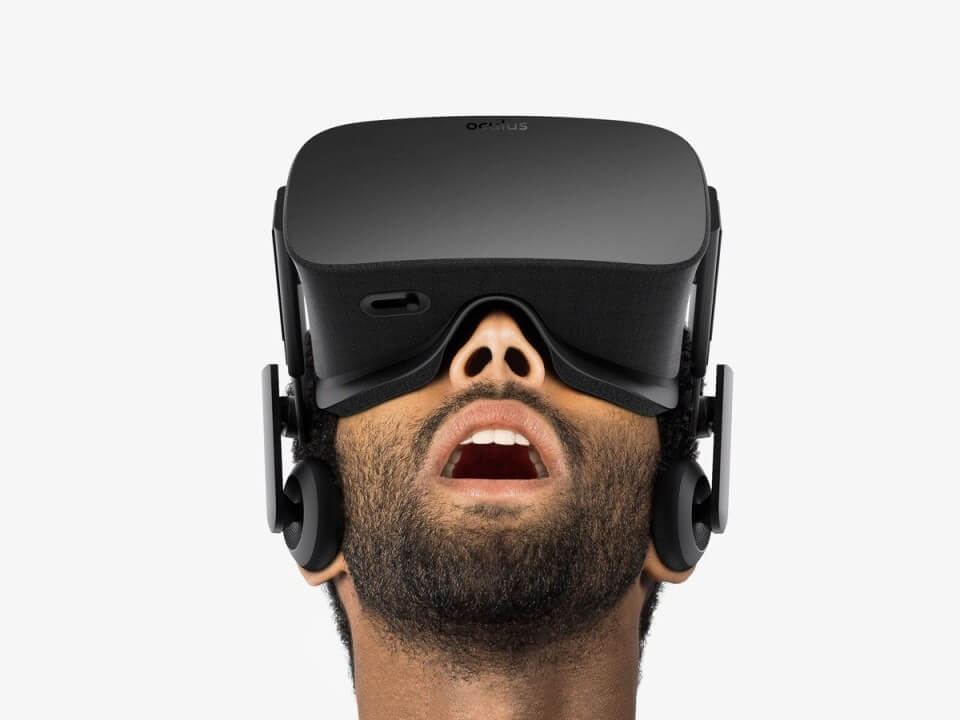
 If you’ve been focused on the ongoing tragedy that is the American political system, you may not have realized that we are about to experience a new technological revolution, one that has the possibility of changing the way we interact with each other, share information, learn, and play.
Next week, hundreds of thousands of people will begin receiving their consumer versions of the Oculus Rift and HTC Vive, two competing systems for transporting people into a computer-generated reality. These systems consist of headsets with high-resolution, wide field of view 3D displays, coupled with tracking systems to measure your head and body movements. The HTC Vive also comes with hand controllers that can be tracked with sub-millimeter accuracy, and room sensors that will track your entire body, also with sub-millimeter accuracy.
The holy grail of VR is to instil a sense of “presence” in the user; i.e., to trick your brain and senses into believing that you are actually in the world projected in front of your eyes, and not just watching a 3D screen. Achieving presence requires a lot of tricks: The displays must respond instantly, with extremely low “latency” and high refresh rates; The resolution must be high enough for your eyes to perceive the scene as real; And the field of view wide enough to encompass your peripheral vision. Body and head tracking has to be accurate below a millimeter. Sounds have to be positional, and change as you move your head. All of these techniques trick your brain into accepting the virtual reality as though it were real.
This level of presence only became technically feasible in the last couple of years. Until now, virtual reality was a nauseating, pixelated potential technology waiting for the requisite advances in sensor, display, and computing technology. That time is now here. I have used this hardware and, believe, me it delivers.
It’s hard to explain what this is like. There seems to be two types of people: Those who have not tried VR and roll their eyes at the hype. They will point out that 3D TV flopped, and this is no different. They believe VR is a passing fad, or at best a niche product.
Then there are the people who have actually tried it, and almost to a person they become instant converts. It’s very hard to describe the first experience of being in a VR world with one of these devices. If you are familiar with the holodeck from Star Trek, that’s probably the closet analogue I can think of. You honestly believe that you are standing in the world the computer has generated for you. It’s unbelievably cool.
Here is an example: This is a video shows Sony’s The Deep demonstration for its Morpheus headset. In this demo, you are teleported into a shark cage and descend into the depths:
Remember, if you are wearing the headset you’re not just seeing this as a video, or even a surround video – it’s all happening in 3D space, and you feel like you are there. Everything has the correct sense of depth.
The applications for virtual reality are unfathomable. Obviously, in the beginning we will be playing a lot of games. Imagine a flight simulator where you are in the cockpit of a P-51 Mustang – look around, and it’s the real thing. With a proper joystick and throttle setup, it will even feel real. A car racing game with a force feedback wheel will be the closest you’ll ever get to actually racing in a real car without being there. Role playing games, first person shooters, and other games will be transformed.
Here’s another good video that shows several VR demos: standing on a sunken ship, climbing Mount Everest, Flying a space fighter , and Portal VR, which teleports you into the universe of the Portal game. (It also contains some zombie carnage starting around the three-minute mark.)
By the way, the accuracy of the controllers is so good that shooting a virtual gun feels like shooting a real one: you aim with your eyes through the sights, and if your aim is true, you’ll hit the target. It’s amazing. Archery games feel like shooting a real bow, and you aim the same way you would in real life.
But games are just the beginning. VR gives us the ability to share experiences the way we share photos today. Manufacturers are now building cameras that shoot entire 360 degree spheres of image. That 360 degree image can then be used to create whatever view you should be seeing when you move your head around. Imagine a camera like this recording the superbowl from the 50 yard line. When you watch that video, your view isn’t locked to the camera as it is today – you can swivel your head around and look anywhere you’d like, just as if you were there. You will feel like you are sitting on the 50 yard line.
These cameras are becoming available as “action cams.” The International Space Station has a 360 degree camera mounted on it. Viewing that video stream, you will feel like you are sitting in space looking around – in near real time. Imagine new landers going to other worlds with such cameras on them. In the future, instead of seeing photos from Mars, you’ll be able to transport yourself to Mars and just look around at whatever you would like.
On a more mundane level, imagine shooting family vacation video using a 360 camera, and then years later being able to re-live the experience as if you were there – even to the point where you can look around and see things you never saw the first time. Sharing a vacation experience with friends will let them see it just as you did – as if they were there with you at the time.
Training and education may be revolutionized. Imagine learning archaeology by being able to virtually transport yourself to real dig sites and walk around them. Imagine being able to learn auto mechanics by having a 3D model of an auto engine right in front of you, with virtual tools to disassemble it, and exploded views that show you the parts. Just “start” the virtual engine, and you’ll be able to see how it all works.
Here is a video of a game where you carry out surgery on a space alien, but it give you an idea of how we can represent and interact with 3D objects in a training environment. It also shows the sub-millimeter accuracy of the controllers that come with the HTC Vive:
Telecommuting just got a whole lot more useful. Today’s corporate telecommuting systems sometimes have cameras that can track to look at the speaker in a room, and there may be large-screen TVs connecting distant locations. Or, we simply connect using Webex or some other tool that creates audio conferences and exposes computer desktops for sharing slides and such. With VR, you can telecommute into a virtual room where multiple people can be sharing information on different whiteboards, where side conversations can take place just by “walking” over to someone, where quick notes can be jotted on boards that everyone can see, and in general where almost all the advantages of being in person are intact.
Virtual Reality is going to be great for the poor. Want to see the Louvre? Or climb Mt. Everest? Or walk along the top of the Great Wall of China? Experiences that were only available to the wealthy will be available for everyone, and for cheap. Travel costs will decline. The need for living and working space may be reduced if people spend more of their time in VR.
These are just some of the obvious things that will come from VR. The truly exciting stuff will only be known once these devices land in the hands of millions and the engine of capitalism and competition causes the kind of advancement we’ve seen with personal computers and smart phones. We don’t know what the future is bringing, but it’s going to be fantastic.
If you want to get started in VR, it’s still fairly pricey. You need a computer powerful enough to render the graphics, which will set you back about $1,000 if you don’t already have one (no Macs have this ability, so it’s a PC-0nly thing right now), or about $350 for a graphics upgrade if you have a powerful PC but not a powerful graphics card. The headsets themselves run from $599 to $799.
There are less expensive options if you want to get your feet wet. If you have a Samsung smartphone, you can buy a Samsung ‘Gear VR’ – a headset that allows you to slide your phone inside to use as the display. It’s only about $100, and doesn’t require a PC at all. Or, if you have a PlayStation 4, Sony has announced a VR headset for it, so no PC required. That will ship in the fall. You can even get a $10 cardboard headset from Google that holds your phone and gives you a similar experience as the Gear VR. These cheaper options have lower resolution and lack some features such as body movement tracking, and the sense of presence may be fleeting, but they’ll let you get familiar with the technology and they are great platforms for watching 360 degree videos and other simple VR experiences.
I’m traditionally a skeptic of sweeping claims made for new technologies. I never thought we’d see widespread flying cars. I knew the Segway wasn’t going to transform our cities. I think high speed rail is a boondoggle in most cases. Attempting to switch our energy infrastructure to renewables is a pipe dream in the short term.
But VR is the real deal. It’s here, and it’s going to be transformative. It might take an additional hardware generation or two before all the features are in place and the cost comes down to where the mass market can afford it, but it holds the potential for changing the way we live at least as much as the smart phone revolution did. If you get the chance, you really need to try it out. Until then, you won’t know what you’re missing.
Published in Science and Technology
Viewing Ricochet in 3D, not 2D, would blow my mind – into 3D bits mind you.
Keep us up to date won’t you? Now I have to go off and learn about these, what did you call them, “smart phones”.
I’m not sure whether I should be terrified by this or look forward to it.
It seems that VR is affordable to me. I’ll still wait until it becomes more mainstream, and there are more applications built around it.
Oh Great! Another excuse to sit on the couch and eat chips(-:
I do wonder how it works for people who don’t have a good sense of depth in their vision.